



Consigne de faire bouillir l’eau : causes, risques et solutions. Comprenez quand et pourquoi ces recommandations sont émises et comment réagir.
Your Cart
(0 products)
Your cart is empty
Access to high-quality drinking water matters in every home, yet choosing the right filtration system can sometimes feel confusing.
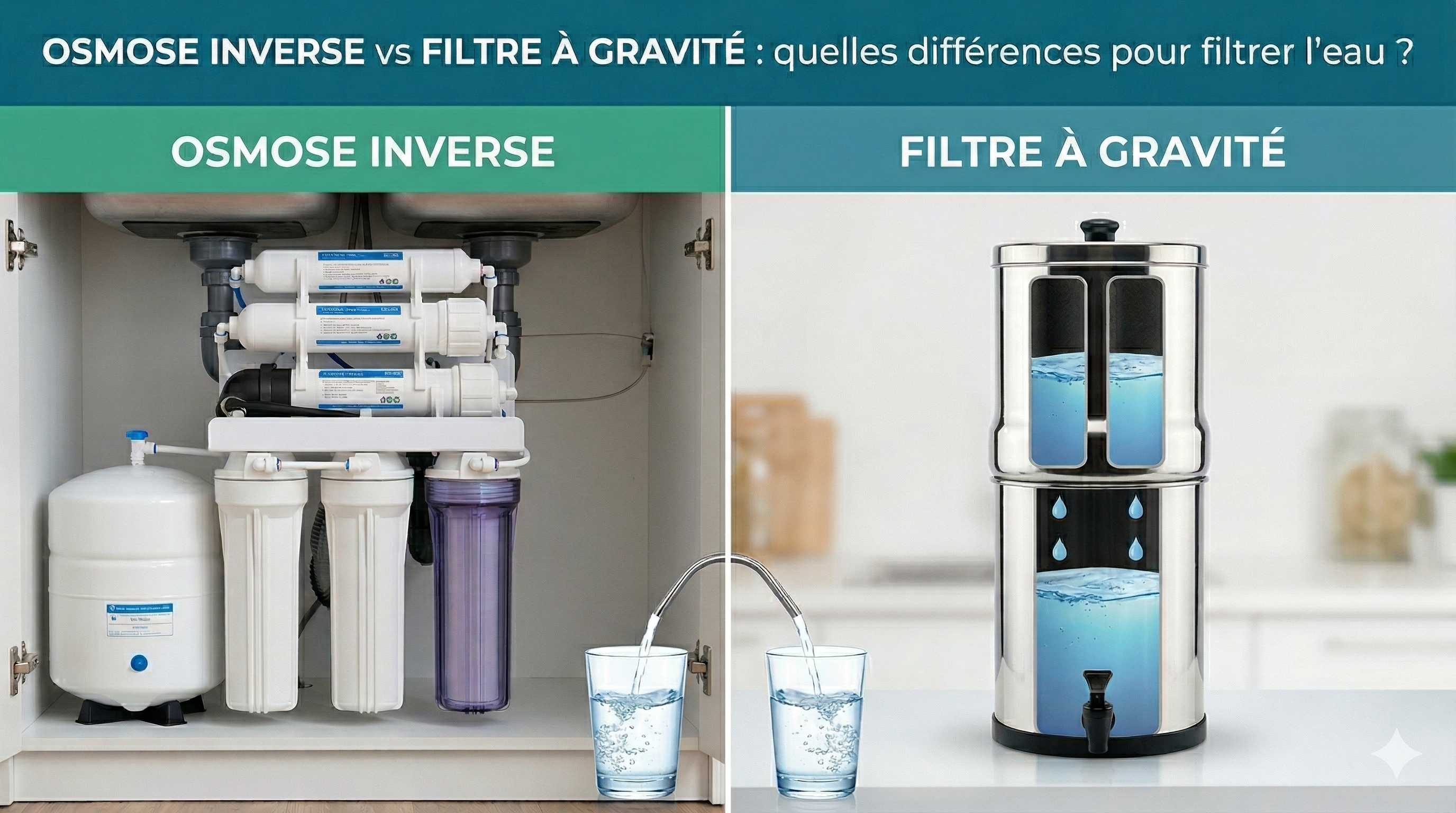
Reverse osmosis and gravity water filters are two widely used technologies for improving drinking water quality. Reverse osmosis systems use a semi-permeable membrane and water pressure to remove dissolved contaminants, while gravity filters rely on activated carbon and hollow fibre filtration that works without electricity or plumbing installation. Each approach removes contaminants differently and suits different household needs.
Both technologies can help reduce certain substances found in drinking water, including PFAS, heavy metals and some chemical pollutants. However, they differ significantly in how they operate, how they are installed and how they affect the mineral content of water.
Understanding these differences makes it easier to choose the solution best suited to your home, lifestyle and concerns about water quality.
Concerns around contaminants such as PFAS have grown in recent years, with multiple studies highlighting their presence in drinking water sources worldwide. To better understand where these substances come from, you can read our guide explaining where PFAS are found in water.
Scientific bodies such as ANSES in France and several European institutions have also highlighted increasing concern over PFAS in the environment and some drinking water resources.
In France, drinking water quality is regularly monitored by health authorities and regional agencies, while the European Union is also working to strengthen regulation around PFAS in the environment and water supplies.

Although both systems aim to improve drinking water quality, they operate on very different principles.
Reverse osmosis systems use pressure to push water through an extremely fine semi-permeable membrane. This membrane helps remove a wide range of dissolved substances, including salts, heavy metals and some chemical contaminants.
Because the membrane is so fine, reverse osmosis systems usually include several filtration stages and are often installed under a sink or on a worktop with a plumbing connection.
Gravity water filters use a simpler principle: gravity pulls water through one or more filter elements. These systems often combine mechanical filtration with activated carbon to help reduce different contaminants.
Because gravity does all the work, these systems need neither electricity nor plumbing. They are typically used as countertop filtration systems.

| Feature | Reverse Osmosis | Gravity Water Filters |
|---|---|---|
| Installation | Requires plumbing installation | No plumbing required |
| Electricity | Usually requires water pressure or a pump | No pressure or electricity needed |
| Waste Water | Produces reject water during filtration | No waste water produced |
| Minerals | Often removes some minerals | Usually retains natural minerals |
| Portability | Fixed installation | Portable countertop system |
| Maintenance | Multiple filters and membrane replacement | Simple cartridge replacement |
Water quality varies by region, but some contaminants appear regularly in water testing:
You can learn more about these substances in our article on the main pollutants found in water.

One important difference between these technologies is their effect on naturally occurring minerals in water.
Reverse osmosis membranes are designed to remove a very broad range of dissolved substances, which often includes minerals such as calcium and magnesium.
Gravity filtration systems using activated carbon and mechanical filters generally focus on reducing contaminants while leaving naturally present minerals in the water.
Both technologies can improve drinking water quality, but the best choice depends on your home and priorities.
Reverse osmosis may suit you if:
Gravity filters may suit you if:
For many households, gravity systems offer an excellent balance between filtration performance, ease of use and everyday practicality.
Studies suggest reverse osmosis systems can reduce many PFAS compounds because of the extremely small membrane pore size.
Some systems using high-quality activated carbon can help reduce certain PFAS and other chemical contaminants, depending on the filter media used.
Most gravity filters are designed to reduce contaminants rather than dissolved minerals, meaning calcium and magnesium usually remain present.
Each technology has strengths: reverse osmosis can remove a wide range of dissolved substances, while gravity filters offer simpler use without electricity, plumbing or waste water.
Both reverse osmosis and gravity filters can help improve drinking water quality.
Reverse osmosis systems provide very fine filtration but usually require installation, plumbing connection and regular maintenance.
Gravity filtration systems offer a simpler alternative. They work through natural water flow, need no electricity, produce no waste water and can be used in a range of settings.
Understanding how each technology works helps you choose the solution best suited to your home, your water quality concerns and your daily routine.
Consigne de faire bouillir l’eau : causes, risques et solutions. Comprenez quand et pourquoi ces recommandations sont émises et comment réagir.
Les nitrates dans l’eau du robinet sont fréquents mais invisibles. Découvrez leur origine, les risques potentiels et les solutions pour mieux comprendre votre eau au quotidien.
Les nitrates sont difficiles à détecter sans analyse. Découvrez comment ils se retrouvent dans l’eau du robinet, pourquoi ils sont surveillés et comment tester votre eau simplement.
Les nitrates peuvent être présents naturellement dans l’eau, mais certaines activités, notamment agricoles, peuvent augmenter leur concentration. Découvrez la limite applicable en France, comment v...
Nitrat kommt natürlich in Böden, Pflanzen und Wasser vor. Erhöhte Konzentrationen können jedoch insbesondere im Grundwasser auftreten. Erfahren Sie, wie der Nitratgrenzwert in Deutschland geregelt ...